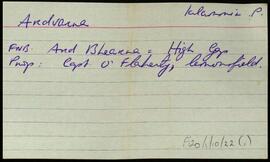
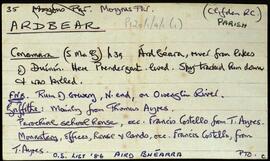
Set of index cards describing some of the natural physical features of the townland of Glionnán/Gleannán [Glennaun]. Anecdotal information from the Annála Beaga, and reference to Ferdinando Follin [Feargananim Folan], the landowner in 1641, later disposed to Sir Thomas Meredith. By the time of the sale of the Martin Estate in 1849, the land was used by tenants for putting cattle out to pasture. Features described include Tamhnach na gCoileach, Cnocán an Bhodaigh, Loch Fhada Ghlionnáin [Glennaun Lodge on the OS maps], and Aill Mhór Ghlionnáin. Some of the information Tim Robinson found for Glennán was in a letter by Eoin Ó'Néill. Seán Ó'Ceoinín is also a local source of information.
UntitledIreland : Townland)
217 Archival description results for Ireland : Townland)
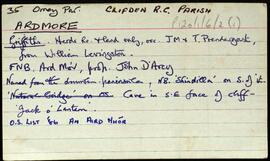
Set of index cards describing the local features of the townland of Muínis [Maínis on logainm.ie, translated into English as Mweenish Island]. Note about ambiguity between Moyrish and Muínis in Simington's 'Books of Survey and Distribution'. Included are descriptions of Feithearnach, Carraig na Blaodhaí, a detailed note on the Estate of Colonel Nolan, sitting MP for North Galway. An Chreig Mhóir, An Sián, a causeway, Trá na mBád, An Cuainín, Muc Ghainimh, Maidhm Mhairtín Thaidhg, Crompán an Chúir, Stupóg an Táilliúrn, Leathrach na mBran (a fishing spot), Leaba Dhiarmaid, Bhéard na gCathasach. An Cuan Mór, Poll an Chora, Aill Chaltha an Aifrinn, Aircín an Mhaide Rámhair, Rinn Bheiglach, Ardskillan, Cibh an Bhéartha, Trá na Dumhaí Bige, Trá Fhada, Leic an Mhuinigh, An Ard-Thrá, Maidhin Mhicil Bhuí, An Garraí Mór, Mweenish Lodge, Carraig an Gharraí Aird, Oileán Lachan (Duck Island on the OS maps), An Dumhach Fhionn, An Aircín Thoir, An tSáilín, Oileán an Chara, Aircín Thiar, Crompán an Liamháin, Tóin Roisín, Trá an Bhoilg, Trá Dheiscirt, An Trá Mhóir, Tobar Cholm Cille, Mac Con Iomaire, Tobar na Seacht nIníon (well of the seven daughters on the OS maps), Loch Varáin, Carraig na mBan, Inis tSruthair, Tonn Uí Floinn, Tóin Ghairbh, An Meall Rua, Cartúr, Portach Mhuínse, Carraig na bPortán, Tobar Cholm Cille, Garraí na nGéabha, Leic na Gharraí Ghainimh, Bóithrí na Trá, Na Corainneacha, Leic na Cora, Coréal Mheaircín, and Clochar an Mhadra Uisce. The word 'local' is written on several of the index cards, indicating that Tim Robinson would have spoken with members of the community, and taken their knowledge of places and spellings in compiling this information. Two individuals are named, Sgt. P O Conaola, and M King of Inis Ní. Several other sources are credited, including Brother Conal Thomas's book 'The Land for the People: The United Irish League and Land Reform in North Galway, 1898-1912', Liosta Focal, Chroí Chonamra, and Nimmo's 1825 map.
UntitledSet of index cards describing the local features of the townland of Maíros/ Maighros [Moyrus]. Several notes on the different formats and spellings of the townland's name. Some of the local features described include Forrest View House, Trá Mhaighrois, Fraochoileán (Freaghillaun on the OS maps), Carraigh Raghnaill and Leathreach Raighnaill (an anecdote about how it is haunted by the hound of a friar), Garbh Charraig, Reilig Mhaighrois, Sruthán Sianach/Tobar Sianach (Toberskeenagh Holy Well on the OS maps), Roisín a tSamha, Cibh an Droighne, Portach Mhaighrois, Abhainn an Mhuilinn (which marks the border between Maighros and An Coillín), Inis Bigir (Bigger's Island on the OS maps). A note in Seán Mac Giollarnath's 'Annála Beaga an Iorras Aitheanta' about buried treasure left there by a 'ceithearnach' (possibly a peasant) from Dumhaigh Ithir. A note about the ruins of the Mission School and Parsonage, which was also the site of a church in the past, but no trace of the church remains. A few graves are to be found, most notably that of Archibald Thomas Hamilton (see Leitir Seanaidh). Various local sources informed the information gathered on this placename, as indicated by the word 'local' on many cards.
UntitledSet of index cards describing the local features of the townland of An Más [Mace]. Features described include Carrig A Mungan, Béal an Mhása An Murlach, Céibh an Mhása (a pier shown on the OS maps), Loch an Phúca, Crompán na gCapall, An Fhuaigh, Na Roisíní, An Damba, and Barr an Mhulaigh. As well as Nimmo's 19th cntury map and un-named local sources of information, Seán McDonncha is credited with providing some of the local information.
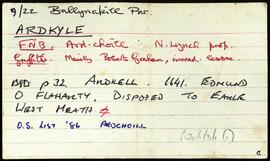
UntitledSet of index cards describing some of the local features of the townland of Ardkyle, [Ardchoill]. Descriptions are given of Freaghillaun South (Freegh Island), Carraig Ghéar (Carrigeen South), Cuainin Garbh, Ross Beach, Poll na gColm (Ooeycolum on the OS maps), Glasoileán, Leac na mBó, Leac na Sronna, and Fruaigh Leathan. Some notes are included offering musings on the meanings of the different place names. Paddy Heanue of Letterbeg, and an old man who lives in the last cottage in Ardkyle are credited as providing some of the information therein. A note on a ruined megalith, 25 metres from a cliff ledge. A letter from Mike Gibbons (1988), is credited as being the source of some of the information.
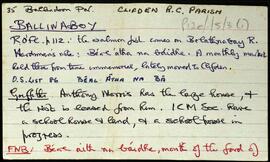
UntitledSet of index cards describing some of the local features of the townland of Ballynew [An Baile Nua]. Descriptions are given of a 'pair of standing stones', Fuaigh an Sconsa (Ooeyasconsa on the OS maps, and known locally as Fo na Sconsaí), Fó na Bróinge (Tim Robinson believes the cove may be named for its boot-like shape), Fó na Labhráis (Ooeylaunlauraush on the OS maps), Fó na Bhistí, Fuaigh an Duine Mhairbe (Ooeywaria on the OS maps), Binn Ghlais, Fó an Uisce, Fó an Bhradáin, Megalithic tombs close to the Children's Burial Ground, Lios (the site of the former Mission School), and the Shrine, which marks the traditional site of St. Ceannan's beheading. J O'Toole of Moyard, Mr. Heanue of Bundouglas, and Con Mullen of Ballynew are credited with providing some of the information.
UntitledSet of index cards describing some of the local features of the townland of Baunoge, [An Bhánóg]. Included are descriptions of the local standing stone, located 400 years North-West of the cemetary, Baunoges graveyard, Shanvallybeg, a description of the Connemara Marble Industries where the film '2000 Light Years Away' was made, a stone alignment, and Crockaunhigeen (Cnocán Uí Uiginn). Gerry Joyce, and Mike Gibbons are credited with providing some of the information.
UntitledSet of index cards describing some of the local features of the townland of Cloon [An Chluain], including a copper mine, Lough Woongar (Loch Moin Gearr), Tuairín na Cloiche Finne, and an overgrown cave. Eileen O'Malley and Patrick Conroy are credited with providing some of the information.
UntitledSet of index cards describing some of the local features of the townland of Curragh [An Currach]. Included are descriptions of Carraig na gCapall, Soul Island, Carraig na bPortán, Inishbroon, Renvyle Point, Bearna Bhuí, Carraig Ghéar, Carraig an Choismeig, An Fó Mhór, Fó Toby, Fóin Fada, Carraig an Ealtóg, Carraig Ramhar, Carraig Ard, Bearna na Gaoithe, Lochán Mór, Aill Mhór, Carraigíní, Carraig an Róist, Fó Mhurchí, Cuainín Bán, Cnocán na Ceilpe, Duirling ó Dheas, Cuainín Labhrais, Leac an tSleabhcáin, Carraig na nGasúr (used to be known as Carraig an Fhómhair, but was renamed after the drowning of six young boys fishing for pollack), An Leac Buí, Idir Dhá Mhaoil, Fó na Fola, Duirling ó Thuaidh, Maol Mór and Maol Beag, Cuanín an tSimléir, Three rocks (named An Lao, An Bhó, and An Tarbh), An Fóin, Carraig an Altóir, Aic an Altóir, Carraig an Bhallaigh Mhóir, An Fóin Fada, Taobh ó Thuaidh, Carraig Uí Garéadáin, Fó Glais, Fó na Rísigh, Béal Gearr, Cathair an Dúin, Cnoc na Síog, The Blake's Farm, and Stáid. Some of the information gathered for this placename was derived from Paddy Heanue of Letterbeg, the CW map, and Paddy Fitzpatrick.
Untitled