Ireland

Elements area

Taxonomy

Code

Scope note(s)

    Source note(s)

      Display note(s)

        Hierarchical terms

        Ireland

          Equivalent terms

          Ireland

            Associated terms

            Ireland

              31 Archival description results for Ireland

              31 results directly related Exclude narrower terms
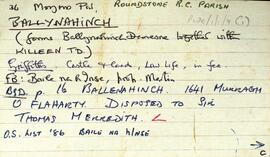
              Ballinahinch
              UGA P/P120/1/1/7/1 · Item
              Part of Personal

              Set of index cards describing physical and historical features in Ballynahinch [Baile na hInse]. A note recounts that horse races used to take place in the townland. An overview of the ownership of Ballynahinch Castle from 1754 is included, from the Martin family, to the Berridge family, the Indian cricketer Ranji Singhi, Dublin ship owning family the MacCormacks, the Irish Tourist Board, to Noel Huggard, who owned Ashford Castle. Some history of the construction of the castle is also provided. Local features in Ballynahinch that are described are St. Fechin's Well, Ballynahinch Fishery, the Carmelite monastery, the stables by the lake, the Piper's Cliff, the church lake and field, the hydroelectric plant, Gate Lodges, Bew island, Ballynahinch Bar, and the Black Gate. Also included is information about the 1849 auction of the Martin's land, as well as information about the Berridge Family and Ranji Singhi. Credited with providing information are N P Wilkins, Val O'Halloran, Phyllis O'Donoghue and her mother, Des Lally, Festy Nee and Gerry Nee. Sources credited include 'Letters from the West of Ireland', the 'Irish Farmers Gazette', and the Irish Architectural Archive.

              Untitled
              Ballinafad
              UGA P/P120/1/1/5/1 · Item
              Part of Personal

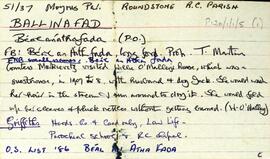
              Set of index cards describing monuments and historical buildings in Ballinafad [Béal an Átha Fada]. Included in the descriptions are the Canal Stage, the islands in Ballinahinch Lake, the Roman Catholic Chapel St. Joseph's, Ballinafad national school, Loch na Brocaí, Cosán an Aifrinn [The Stirabout Road], Hynes' Park, St. Andrew's Bay, and Lisnabrucka. Mr. and Mrs. Willie O'Malley of Ballinafad are credited as being the sources of some of this information. Includes an anecdote about Countess Markievicz's visit to Ballinafad in 1907.

              Untitled
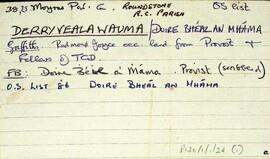
              Derryvealawauma
              UGA P/P120/1/1/24/1 · Item
              Part of Personal

              Set of index cards describing some of the physical features of Derryvealawauma [Doire Bhéal an Mháma]. Included in the descriptions are Cnoc Doire Bhéal an Mháma, Port an Dúín, Log Mhám Té, the Children's Burial Ground, Máméan, and Bun an Chnoic. A note on Bun na gCnoc and its status as a Gaeltacht during the Recess school boycott. Local Tamhnach Mór and Leitheanach people are credited with providing some of the information.

              Untitled
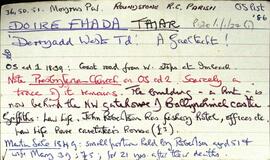
              Doire Fhada Thiar
              UGA P/P120/1/1/27/1 · Item
              Part of Personal

              Set of index cards describing some of the local features of Doire Fhada Thiar [Derryadd West], a Gaeltacht area. Included in the descriptions are a note about the ruins of a Presbyterian Church, The Angler's Return (includes some notes on the Robertson family), Cor na mBriathare, Aill na gCúil, the fishery, the dyke, Botha Guaire, Sruthán Dearg, Céibhín Ghleann Aighneach, Lochán an Chaoile, Caorán an Iolra, Cloonisle Quay, Loch an Doirín, Aill an Eibhinn, Abhainn Mhór, The Fishery Hill, Caorán na Scraithe, and Imlach. Locals Pat and Annie Conneely, and Joe Nee credited with providing some of the information.

              Untitled
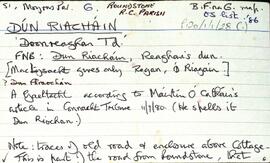
              Dún Riacháin
              UGA P/P120/1/1/28/1 · Item
              Part of Personal

              Set of index cards describing some of the local features of Dún Riacháin [Doonreaghan], a Gaeltacht area. The features described include Cora Hara, Doon House (originally the home of the Hazell family), Aill an Eibhinn, the Cashel Training Centre, Log an Iarainn, Caladh Mharcuis, and Fox Island. Tom Conneely was a local source who provided some of the information relating to this townland. Tom McDonagh of Tamhnach Bán told a story of a fox and a limpet in connection with the naming of Fox Island.

              Untitled
              Inis Ní
              UGA P/P120/1/1/37/1 · Item
              Part of Personal

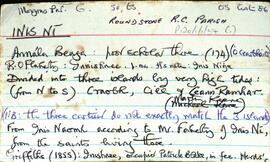
              Set of index cards describing the physical features of Inis Ní [Inishnee]. Located in Moyrus Civil Paris, and the Roman Catholic Parish of Roundstone. Robinson explains that Inis Ní is divided into three islands by very high tides. From North to South, these are Craobh, Cill, and An Ceann Ramhar. Data from the 1820, 1841, and 1851 census returns are included, Congested Districts Board data, some history of ownership dating back to the 16th century, and some information from the 1st Report of the Fishery Commissioners in 1836. Physical features which are described are: Tobar Cholm Cille [on the OS map, St Brendan's Monument is marked in the same place], Árd na gCapall, Caladh na bPortán, Caladh Flathartaigh, An Sruthar, Cloch Mhór Róisín, Poll Pháidí, Caladh Keane, Tuairín, Cora Mhór, Scaith Dhubh, Caorán, Glasoileán, Gleann na gCoileach, Carraig an Bhranda, Oileán an Chlaí, Loch Bheag, Gleann na gCat, Cnocán Mhairgín, An Storraicín [An Stoiricín], Aille an Gharraí Rua, Aille na Caillí, Cara Beag(a), Doilín Freangach, Caladh Cam, Cuan Leice, Poll Tobac, St. Mathias's Chapel, Na Bruachaí [Mud Hole], Maoilín Dóite, Cáblachaí, Caladh na Loinge, St. Brendan's Well, Inis Ní Lighthouse, Gleann na gCapall, Troscaí, Cnocán Árd Dhaibhéis, Oileán an Choirce, Aill na nÉan, Dóilín Mhór, Bóthrín Gaskin, An Chloch Bhiorrach, Croabh [Creevecarton], An Ceann Ramhar, Cill, Aill Dingle, An Duirling Bhán, Crompán Mór, Oileán na gCapall, Caladh Bháid Mhóir, Gleann Dúlamáin, Cnocán an Tuairín, An Comhartha, Cnocán Tine Cnáimh, Giúróg, Mhaidin an tSagairt, Cora Mháire Ní Iarla, Doire Fhatharta, Donegal, Carraig an Fox (connected with the story of the fox and the limpet - see also Fox Island, near Cashel), Cnocán an Fhatharta, Coirnéal Sáraithe, Cooneen na Roan, Cuainín, the Inis Ní Bridge, The Wire, Fort Island, Inis Ní National School, Muing na Fola, Daoláin, Tobar an Rí, and The Danes Fort. Many local sources are credited with providing information and stories. Those credited are Pádraig Nee, Festy Nee, Rose Green, Michael King, Mr Faherty, Martin Keene, Michael Keane, Conor Hamill, Paddy Folan, and Nimmo's map of 1823.
              Untitled
              An Ros Rua
              UGA P/P120/1/1/51/1 · Item
              Part of Personal

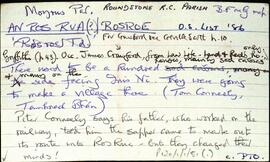
              Set of index cards describing some of the features of An Ros Rua [Rosroe]. Robinson quotes local sources in summarising the history of the village in the 19th century, once quite a busy harbour, but declining as a village early into the Famine. Features described include the Rosroe Boat Harbour, a marsh North-West of Rosroe Lough called Muing Sanders, Cnocán Rí, Tamhnach Mór, The Lily Lake, Rosroe Bay, Bun a Trinse, Caladh Bháid Mhóir, Cora an Trá, The Poorhouse, Sruthair na Míoltóg, Cora an tSalainn, Loch Stiofáin Uí Mhongáin, Cora Phádraig, Cora Raithní, Loch Barr an Bhaile (where Marconi experimented with kites), and Locháin an Dubhaigh (The Mud Holes). Credited with providing information are Tom and Peter Conneely, Joe Joyce, Tom Conneely, and Joe Joyce.

              Untitled
              Cloch na Rón
              UGA P/P120/1/1/55/1 · Item
              Part of Personal

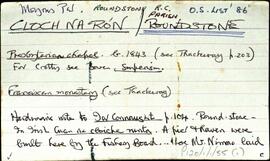
              Set of index cards describing some of the local ecclesiastical, historical, and geographical features of Roundstone, [Cloch na Rón]. Background information sourced from Hardiman, and from the 1849 sale of the Martin Estate which covers the building of a pier there by the Fisheries Board and Alexander Nimmo. Included in the descriptions are the 19th century Protestant Church and its memorials, the Presbyterian Meeting House which was demolished in 1930, the Presbyterian Church, the Franciscan Monastery, The Fort, (occupied for a while by Sting of 'The Police'), The Old Store, Garryowen, Srutháin na Srúille, the Harbour, Ballagh House, Roundstone Bay, Waymount, Clougherty's (a shop and pub, and the site of the current Garda station), Bólard, the Coastguard's Office (referred to as The Boat House in 1899 map), Farrell's Road (a site of several Famine graves), Ballagh House, Newton Buildings (now the site of the local Health Centre), The Old Quay, the Catholic Church which was built in 1830, and the knitting factory. Summary of some of the information from the Royal Commision of Inquiry into the State of Irish Fisheries, 1836, from the Roundstone Famine Relief Committee, and from the Martin Estate Sale document of 1849. One card giving an account entitled 'The Story of Alice', referring to Alice McCaulter. Noel King, Michael Verron, M. Bairéad, and John McQuaid are all credited with providing some of the information and anecdotes in these notes. The Galway Vindicator was also a source of information about the Roundstone Famine Relief Committee.

              Untitled
              Iorrus Aithneach
              UGA P/P120/1/2/1/1 · Item
              Part of Personal

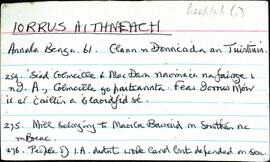
              Set of index cards describing some of the history of Iorrus Aithneach [Iorras Aintheach], and how its local people have survived of the past few hundred years. A mill, and working the sea were its residents' two main occupations, with some seasonal work described here.

              Untitled
              Cill Chiaráin
              UGA P/P120/1/2/11/1 · Item
              Part of Personal

              Set of index cards describing some of the features of the townland of Cill Chiaráin [Kilkieran]. One card summarising information from the Irish Wasteland Improvement Society. Features described include An Gleann Mór, Glenmore House (a history of its ownership), Teach Pobail Chill Chiaráin (which dates back to 1879), Comharchumann Chonamara Thiar, a note on the Irish Salmon Producers Group, Crocán na Sealaíocht, Cnocán na mBuachaillí, Tobar Muire, St. Kieran's Church (known locally as Leaba Chiaráin, Caladh na gClimíní, Droighneach, Cnoc Binn Bhuí, Cionlaí, Aill na Brón, Bánrach Árd, An Chathair, Coradh na gCuaig, Sliabe Doite, An Bhrocach, Crompán Bréan, Crompán an Mhaide, Cloch na gCailleach, Crompán an bhFiann, Carraig Mhór, Loch na Sióige, Aill na Méaracán, Cora na gCapall, Oileán an Charnáin, Log Riabhach, An Roisín, a card listing some of the businesses in the village of Cill Chiaráin, Crompán Beag, An Crompán Mór, Loch an Óir, and Abhainn an Mhuilinn. Some local people are named, credited with providing some of the information about the townland. These are Seán O'Ceoinín, Martin Smith, Eoin O'Néill, Máire Canavan, M. O'Conghaile.

              Untitled