Ireland

Elements area

Taxonomy

Code

Scope note(s)

    Source note(s)

      Display note(s)

        Hierarchical terms

        Ireland

          Equivalent terms

          Ireland

            Associated terms

            Ireland

              3 Archival description results for Ireland

              3 results directly related Exclude narrower terms
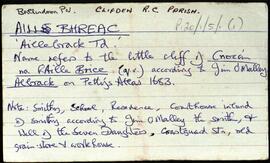
              Aill Bhreac
              UGA P/P120/1/5/1/1 · Item
              Part of Personal

              Set of index cards describing some of the local features of the townland of (An) Aill Bhreac, [Aillebrack]. Included among the set of cards are descriptions of Carraig an Lios (more familiar to locals as Carraig Áilis, or Ailice's rock, used as a place to bury children until 1803), Split Rock, Cnocán Breac (Guaire na bpáistide in the Field Name Book), Holy Well and Mass Rock, Cé Bhun Abhann, Maidhm Cromaill (Cromwell Shoal), Straw Beach Island, Loch Caffrey, Bóithrín Beag, Lochán Buí, Oileán Ura (Illaunurra), Loch an Doirín, Sand Lake, Dóilainn Harbour, Cnocán na hAille Brice, Horse Island, the Well of the Seven Daughters (sometimes known locally as the Well of the Seven Sisters), Midden, Creig, Carraig Cumair, Carraig an Ghamhna (Calf Island), Buachaill (Boughillcarrickcark/Bóchaill), Carraig an Locháin, Carrach an tSeoighe, Corrach an tSrutha, Corrán, Tóin an Rosa, Carraig an Fhuaruisce, the Coastguard Station, Murlach, For Buaile, the Children's Burial Ground, Carraig an Fhioruisce, Corrán Beag, and Corrán Mór. Seán King of Ballyconneely, Martin O'Malley of Roundstone, and local man Jim O'Malley are credited with providing some of the information.

              Robinson,Tim,O'Malley,Martin,King,Seán,Jim
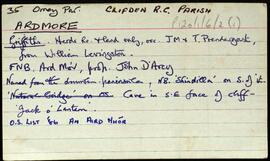
              Ardmore
              UGA P/P120/1/6/2/1 · Item
              Part of Personal

              Set of index cards describing some of the local features of the townland of Ardmore, [An Aird Mhóir]. Included are descriptions of Caladh Mór, the grave of a French sailor buried under rock almost 100 years ago, Duinín, Carraig na hOillaine, Sindile (an islet, Tim Robinson describes the profile as that of a beater, and includes a small sketch), Corrán, and a small cave known locally as 'Jack of the Lanterns'. Patrick Mullen (et al), and Mr. MacDonagh of Eyrephort are credited as being sources of some of the local information.

              Robinson,Tim,Mullen,Patrick
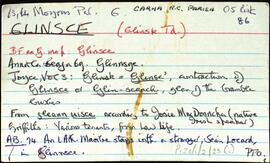
              Glinsce
              UGA P/P120/1/2/23/1 · Item
              Part of Personal

              Set of index cards describing some of the natural physical features of the townland of Glinsce [Glinsk]. Various sources are referenced giving insights into the origin of the placename, from Patrick Weston Joyce's 'The Origin and History of Irish Names of Places, Vol 3', which interprets it as the glen of the bramble bushes, to a local man who believes it derrives from 'gleann uisce'. Some notes are also provided on the modern day uses of buildings referenced in the OS maps, for instance the local school, Glinsk House, and Marble Studio. The physical features described are Loch an Roisín, Rusheen Point, Cnoc Glinsce, An Charraig Leith, Caladh Beag, An Caladh Mór, Corrán, a Children's Burial Ground, Loch Bhairtle, Barr an Linnín, Cnoc Bharr an Linnín, Abhainn Bharr an Linnín, Loch Cnocán na gCalapp, Caladh Thiobóid, Loch na Dubhaí (Lough Peastia on the OS maps, from the Irish word for worm, péist), Loichín Bharr an Chriathrach, Barr an Chlaí, Loch an Chaoráin, Céibh an Chaltha Mháire, Loch an Tamhnaigh, Tamhnachaí, Loch na Liathróide, Tulach na mBan, Loch an Mheill Mhóir, Tobar Mhuire, and Cuan na Beirtrí Buí. Information sourced from Bedford's map, Annála Beaga, and locally from Seán Ó'Ceoinín, Josie McDonncha, Frank Keaney and his grandmother, Josie Phádraig Cionnaigh, and Tomás Ó'Conghaile.

              Robinson,Tim,Ó'Ceoinín,Seán,McDonncha,Josie,Keaney,Frank,Cionnaigh,Josie Phádraig,Ó'Conghaile,Tomás