Annotated and corrected excerpts from Kerby A. Miller's original transcript of Tim Cashman's memoir Memories (1929), plus photocopies of some of the original manuscript pages. The full memoir and transcript are found at P155/16/1/1/1.
-Kerby A. Miller's typed transcript of Tim Cashman's memoir and two earlier typed transcripts, one included with a donor letter;
-citations and photocopies of secondary sources; census research;
-Miller's correspondence with colleagues, researchers, and Cashman relatives;
-copies of newspaper clippings and the mass card for Tim Cashman;
-a photocopy of a letter from Dan Cashman in Canada in 1923;
-a photocopy of the original memoir; photocopied letter from Neilí Ní Bhriain discussing support for Coláiste Eoghain Uí Chomhraidhe in Clare in 1913;
-copies of photographs of Tim and Dan Cashman;
-a photocopy of Tim Cashman's handwritten excerpts from various texts in both English and Irish, which also appear as part of his memoir;
-Miller's research notes.
Materials pertaining to the writings of brothers Tim and Dan Cashman. Tim Cashman (b. 1866) and Dan Cashman (b. 1872) were from Killeagh, near Youghal, County Cork and emigrated in the early 1890s. Per Kerby A. Miller: 'In many ways, their lives and writings (in both Irish and English) provide a microcosm of Irish-American society-at least of the dwindling numbers of Irish-born-during the Irish Nationalist fervor of the early 20th century. Tim and Dan Cashman's parents were poor Irish-speaking farm laborers, and both brothers worked as unskilled laborers in American factories, docks, and mines in Boston and the Far West. Their memoirs and poems, which reflected on their lives in Ireland and America, show a strong class-consciousness-a deep resentment against social exclusion and exploitation on both sides of the Atlantic. Both brothers remained emotionally centered on Ireland rather than their adopted country, and both dreamed that a successful revolution would create an egalitarian, as well as a politically independent, Ireland. However, Tim Cashman's dreams were expressed through petty-bourgeois forms of "advanced" Irish-American nationalism, such as Clan-na-Gael and the Gaelic League, whereas brother Dan embraced the social radicalism of James Connolly and, especially, 'Big Jim' Larkin, and was likely a member of the revolutionary syndicalist IWW. Although they divided politically over the 1921 Treaty and the subsequent Civil War, both "lost" the Irish republics of their dreams: Dan Cashman never returned to an Irish Free State he despised, and Tim Cashman's sole visit "home" in 1925 was deeply disappointing. In the end, both brothers had to settle for-and die in-an American society that had never matched their expectations or engaged their imaginations.'

Alternate copies of Tim Cashman's memoir Memories (1929), including photostats and portions of Kerby A. Miller's original transcript. Tim Cashman (b. 1866) and Dan Cashman (b. 1872) were from Killeagh, near Youghal, County Cork and emigrated in the early 1890s. Per Kerby A. Miller: 'In many ways, their lives and writings (in both Irish and English) provide a microcosm of Irish-American society-at least of the dwindling numbers of Irish-born-during the Irish Nationalist fervor of the early 20th century. Tim and Dan Cashman's parents were poor Irish-speaking farm laborers, and both brothers worked as unskilled laborers in American factories, docks, and mines in Boston and the Far West. Their memoirs and poems, which reflected on their lives in Ireland and America, show a strong class-consciousness-a deep resentment against social exclusion and exploitation on both sides of the Atlantic. Both brothers remained emotionally centered on Ireland rather than their adopted country, and both dreamed that a successful revolution would create an egalitarian, as well as a politically independent, Ireland. However, Tim Cashman's dreams were expressed through petty-bourgeois forms of "advanced" Irish-American nationalism, such as Clan-na-Gael and the Gaelic League, whereas brother Dan embraced the social radicalism of James Connolly and, especially, 'Big Jim' Larkin, and was likely a member of the revolutionary syndicalist IWW. Although they divided politically over the 1921 Treaty and the subsequent Civil War, both "lost" the Irish republics of their dreams: Dan Cashman never returned to an Irish Free State he despised, and Tim Cashman's sole visit "home" in 1925 was deeply disappointing. In the end, both brothers had to settle for-and die in-an American society that had never matched their expectations or engaged their imaginations.'
Printed programme from Focus Theatre, Dublin, production of "Tillsonburg" written by Malachy McKenna and directed by Liam Heffernan. Includes biographies of cast members.
6 negative images, difficult to make out, but written on the sheet are the index terms “Maire Aine Ni Cuaig”, and “Ti Darby, Pléaracha, Saw Doctors”.
15 images on negative and contact sheets.
Photographs entitled “Tí Darby, the end”, photographs of its demolition.
Photograph of John Joyce at work with a saw and piece of wood.
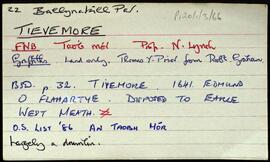
Index card relating to the townland of Tievegarriff, [An Taobh Garbh]. Brief information derived from Griffith's Valuation, and the relevant Field Name Book.