Set in index cards describing some of the local features of the townland of Annaghkeelaun, [Eanach Caoláin]. A note on Corrib View, a house overlooking Lough Corrib. And a note on Knockilry, a burial place on the northern extremity of the townland.

Set in index cards describing some of the local features of the townland of Annaghkeelaun, [Eanach Caoláin]. A note on Corrib View, a house overlooking Lough Corrib. And a note on Knockilry, a burial place on the northern extremity of the townland.
Robinson,TimSet of index cards describing some of the local features of the townland of Annaghvaan, [Eanach Mheáin]. Inis Loiste, Oileán a ghreasaide, Crompán Mór, and Cor na dtrachta are some of the local features briefly described.

Set of index cards describing some of the local features of the townland of Annaghvaan, [Eanach Mheáin]. Inis Loiste, Oileán a ghreasaide, Crompán Mór, and Cor na dtrachta are some of the local features briefly described.
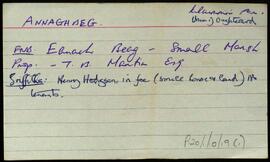
Robinson,TimA brief index card relating to the townland of Annaghbeg, [Coill an Eanaigh]. Includes a note from Griffith's Valuation.

A brief index card relating to the townland of Annaghwood, [Coill an Eanaigh]. Includes a note from Griffith's Valuation.
Robinson,TimMaterials pertaining to a set of six letters written between 1851 and 1870 to Father Clement Reville, a member of the Franciscan community in Wexford town. Five of these letters were written by Irish emigrants Ann (or Anne) Brown and William Heatley who settled in northeastern Iowa near Dubuque as part of an Irish Catholic farming colony; A sixth letter was written by Anne Parle, an emigrant to Cincinnati.
Also present are transcripts of three letters sent to Father James Burke of Limerick during 1879 and 1880 from nuns in Presentation Convent, St. John's, Newfoundland. Per Father Bartholomew Egan: 'Long before Gander or Garryowen found a place on the aviator's maps as the terminal points for the North Atlantic hop, Limerick itself had an important ecclesiastical link with Newfoundland. From 1850 until his death in 1869 the Bishop of St. John's was a Franciscan named John Thomas Mullock, son of a Limerick business man. Bishop Mullock was born at Arthurs' Quay in 1807 and left for Cadiz in Spain on a Portuguese ship in 1825. He joined the Franciscan Order there and was professed in October 1827. Later he proceeded to Rome where he was ordained priest on 10 April 1830. Back in Ireland he spent a brief period in his native city before being elected Guardian of Ennis in 1831. Here his administrative industry and ability manifested themselves. It was he who purchased the first house at Bow Lane which eventually developed in the modern friary. In time he filled posts as Guardian of the friaries at Cork and Limerick, and was also a senior assistant to successive Provincials. On 27 January 1848 Cardinal Fransoni ordained him Coadjutor Bishop of St. John's Newfoundland and he set sail for the Western Hemisphere a few months later. On arrival at St. John's, he received an enthusiastic welcome from Catholic and non-Catholic alike, including the British Governor. When Bishop Fleming died in 1850, Bishop Mullock took complete charge of the diocese. He visited Ireland in 1867 and died in his adopted country on 29 March 1869. During his time in Newfoundland he erected a new convent for the Presentation Sisters which is now the Motherhouse of the Congregation in that country. His own sister had become a Presentation nun and followed her brother to the mission. Two letters from her to Father James Burke of the Limerick Friary are printed here; also one from a Mrs. Wilson. They contain some interesting historical titbits.''
The series contains the letter transcripts and some reproductions, along with Kerby A. Miller's research on letter authors Ann(e) Brown and Anne Parle and Miller's research on Catholic emigration to the Dubuque and Cincinnati areas.
-Letters written by Ann(e) Brown;
-Kerby A. Miller's research on Brown;
-notes on Brown, her family, and their emigration passages;
-biographical notes on Father Clement Reville;
-notes on the Father Hore Irish Catholic settlement in eastern Iowa from where most of the letters were sent;
-Miller's transcripts of the letters received by Father Reville with annotations and corrections;
-correspondence between Miller and donors Rev. Bartholomew Egan and Jim Rees;
-Rev. Egan's transcripts of the Presentation Convent letters as presented in his article 'A Newfoundland Link with Limerick in Pre Aviation Days';
-Rees' 1996 article 'Wexford Landing, Iowa 1851' which includes his transcript of the William Heatley letter as well as a reproduction;
-reproductions of the Reville letters.