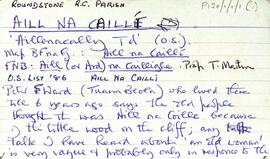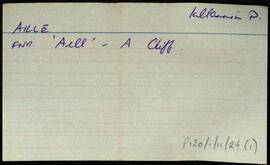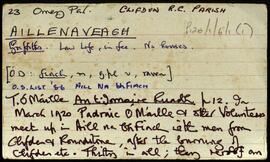
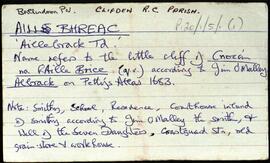
Set of index cards describing some of the local features of the townland of (An) Aill Bhreac, [Aillebrack]. Included among the set of cards are descriptions of Carraig an Lios (more familiar to locals as Carraig Áilis, or Ailice's rock, used as a place to bury children until 1803), Split Rock, Cnocán Breac (Guaire na bpáistide in the Field Name Book), Holy Well and Mass Rock, Cé Bhun Abhann, Maidhm Cromaill (Cromwell Shoal), Straw Beach Island, Loch Caffrey, Bóithrín Beag, Lochán Buí, Oileán Ura (Illaunurra), Loch an Doirín, Sand Lake, Dóilainn Harbour, Cnocán na hAille Brice, Horse Island, the Well of the Seven Daughters (sometimes known locally as the Well of the Seven Sisters), Midden, Creig, Carraig Cumair, Carraig an Ghamhna (Calf Island), Buachaill (Boughillcarrickcark/Bóchaill), Carraig an Locháin, Carrach an tSeoighe, Corrach an tSrutha, Corrán, Tóin an Rosa, Carraig an Fhuaruisce, the Coastguard Station, Murlach, For Buaile, the Children's Burial Ground, Carraig an Fhioruisce, Corrán Beag, and Corrán Mór. Seán King of Ballyconneely, Martin O'Malley of Roundstone, and local man Jim O'Malley are credited with providing some of the information.
Robinson,Tim,O'Malley,Martin,King,Seán,Jim